Background and Objectives of the Conference
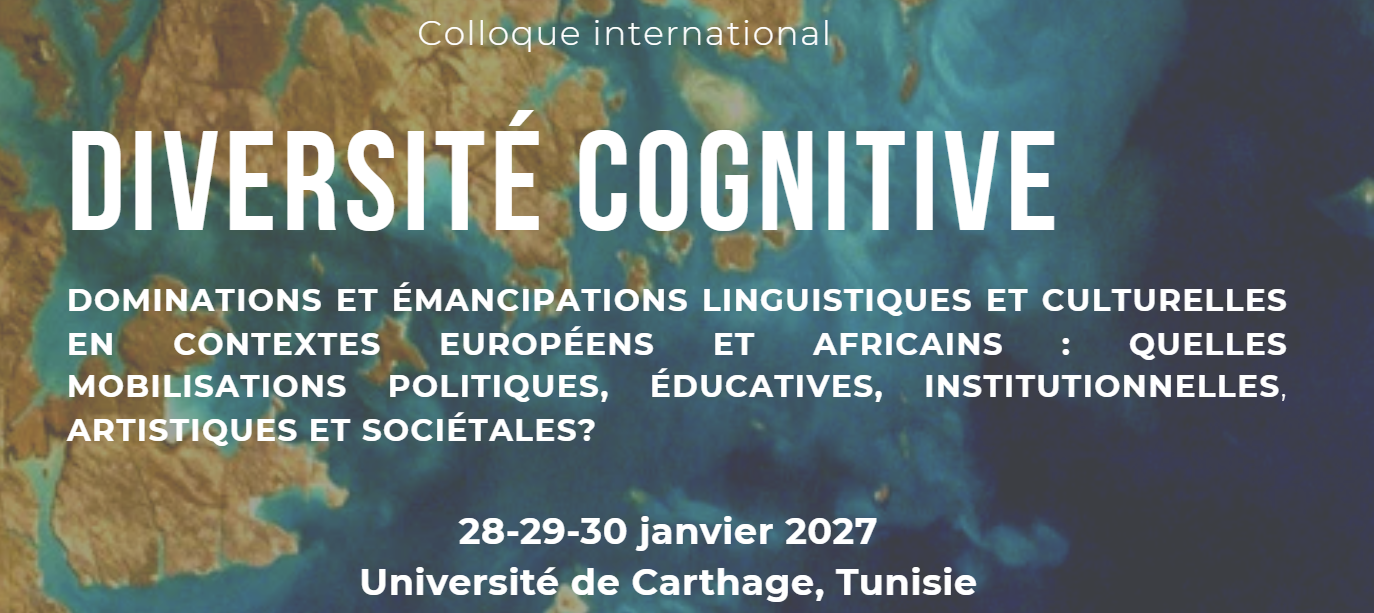
International Conference
Cognitive Diversity
Linguistic and Cultural Domination and Emancipation in European and African Contexts: What Political, Educational, Institutional, Artistic, and Societal Movements?
January 28, 29, and 30, 2027
University of Carthage – Tunisia
In a global context marked by the intensification of human, informational, and cultural flows, but also by persistent economic divides and geopolitical tensions, languages and cultures are more than ever embedded in asymmetrical power relations. Globalization of exchanges indeed promotes the rapid spread of certain languages and cultural models, while other forms of linguistic and symbolic expression remain marginalized or weakened. The resulting discursive homogenization tends to reduce the plurality of perspectives by establishing implicit hierarchies among languages, knowledge, memories, and modes of thought. In this context, so-called marginalized or minority languages and cultures are often subjected to processes of invisibilization or devaluation, which contribute to the reproduction of mechanisms of exclusion and domination. These phenomena have been extensively analyzed by various critical traditions, notably through the concepts of linguistic and cultural imperialism, epistemicide, linguistic justice, and symbolic domination, which shed light on the close links between power, language, and the production of knowledge, as well as the conditions for access to recognition, particularly statutory recognition.
This conference aims to examine the dynamics underlying linguistic and cultural actions, discourses, and practices that seek to challenge these dominant orders or to make marginalized knowledge, identities, and forms of expression visible. The aim will be to examine, within European and African contexts, contemporary forms of domination and strategies of emancipation that unfold at the intersection of the political, educational, cultural, and artistic spheres, as well as the legal and social spheres.
Temes of the conference
Proposals may address one or more of the following themes (non-exhaustive list)
- Practices of resistance and linguistic mobilization (social, artistic, legal, and political spheres; issues of activism, etc.)
- Analysis of power relations: Language, law, institutions, and access to justice (in institutional, legal, medical, educational, and cultural contexts, etc.)
- Epistemic alternatives and the plurality of knowledge (cognitive diversity, translation, interpretation, the role of marginalized voices, questioning concepts of the universal and otherness...)
- Relationships of domination and linguistic inequalities in institutional contexts (Analysis of power mechanisms in educational, medical, administrative, and judicial spheres; language hierarchies; legitimization/delegitimization of discursive practices)
- Normative and systemic transformations of knowledge institutions and linguistic and cultural mediation (law, linguistic and cultural justice, didactic and pedagogical systems, public outreach, interpreting, etc.)
- Cultural and artistic expressions (literature, film, theater, performance, orality, etc.)
Calendar
Call for papers opens: April 15, 2026
Abstract submission deadline: May 31, 2026
Notification of acceptance and requests for revisions: July 1, 2026
Final manuscript submission deadline: November 1, 2026
Conference Partners