
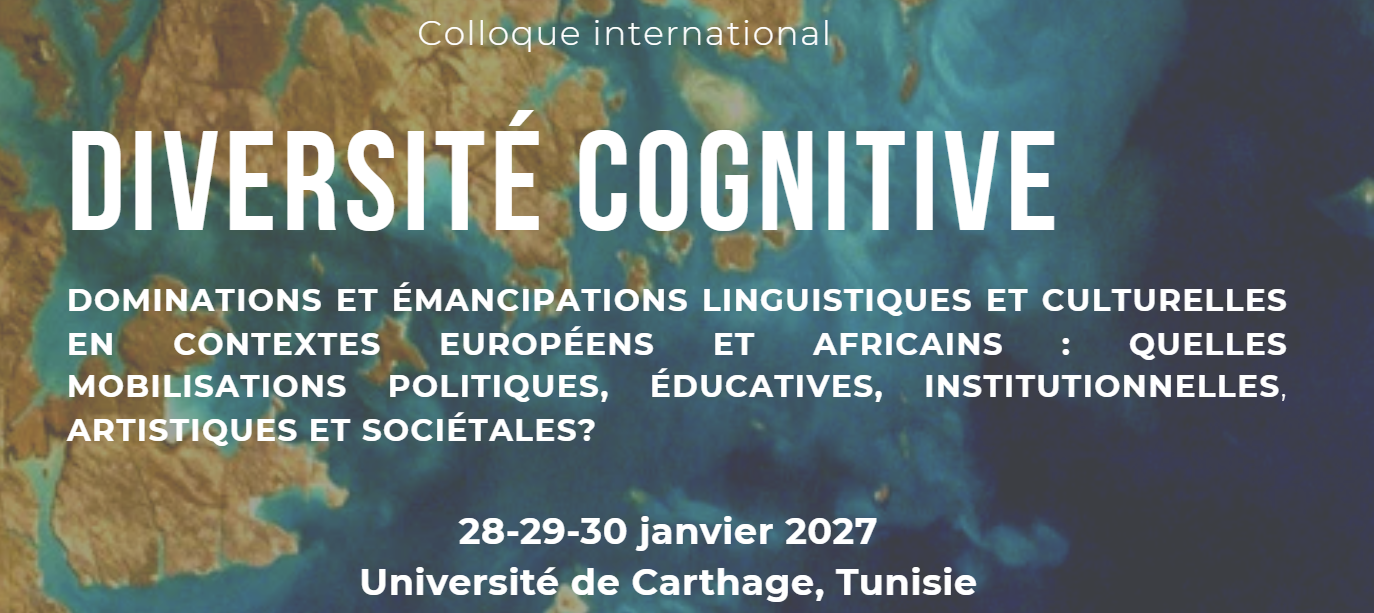
International Conference
Cognitive Diversity
Linguistic and Cultural Domination and Emancipation in European and African Contexts: What Political, Educational, Institutional, Artistic, and Societal Movements?
January 28, 29, and 30, 2027
University of Carthage – Tunisia
In a global context marked by the intensification of human, informational, and cultural flows, but also by persistent economic divides and geopolitical tensions, languages and cultures are more than ever embedded in asymmetrical power relations. Globalization of exchanges indeed promotes the rapid spread of certain languages and cultural models, while other forms of linguistic and symbolic expression remain marginalized or weakened. The resulting discursive homogenization tends to reduce the plurality of perspectives by establishing implicit hierarchies among languages, knowledge, memories, and modes of thought. In this context, so-called marginalized or minority languages and cultures are often subjected to processes of invisibilization or devaluation, which contribute to the reproduction of mechanisms of exclusion and domination. These phenomena have been extensively analyzed by various critical traditions, notably through the concepts of linguistic and cultural imperialism, epistemicide, linguistic justice, and symbolic domination, which shed light on the close links between power, language, and the production of knowledge, as well as the conditions for access to recognition, particularly statutory recognition.
This conference aims to examine the dynamics underlying linguistic and cultural actions, discourses, and practices that seek to challenge these dominant orders or to make marginalized knowledge, identities, and forms of expression visible. The aim will be to examine, within European and African contexts, contemporary forms of domination and strategies of emancipation that unfold at the intersection of the political, educational, cultural, and artistic spheres, as well as the legal and social spheres.
The forms of resistance emerging in social, educational, institutional, and cultural spheres today take on diverse and sometimes unprecedented forms. It can be expressed, in particular, through initiatives to revitalize endangered languages, efforts at narrative reappropriation through which communities redefine their own history, or through the production of situated knowledge that challenges the supposed universality of certain scientific paradigms. Other forms of resistance involve reclaiming discursive spaces in the media, art, or literature, as well as the development of inclusive educational practices that are attentive to the linguistic and cultural diversity of learners and to linguistic rights.
From this perspective, the discussion will also focus on the concept of cognitive diversity and the conditions for a possible decolonization of knowledge. In particular, this will involve considering languages and cultures not merely as means of communication, but as genuine epistemic matrices, carrying specific and legitimate worldviews, categories of analysis, and forms of rationality. Such an approach invites us to consider linguistic and cultural pluralism from an ecosystemic perspective, grounded in the coexistence, negotiation, and mutual transformation of knowledge systems and cultural practices.
The concept of pluralism in linguistics also leads to an examination of the institutional and pedagogical dimensions of language policies. It involves assessing the respective roles of first, second, and teaching languages, and identifying which languages are used in administration, whether dominant or minority. This issue is particularly acute in nation-states with a colonial history, in societies characterized by significant cultural and linguistic diversity or by high levels of migration, where the language choices of educational, administrative, and judicial institutions contribute to the construction of symbolic and social hierarchies.
The conference thus aims to bring together researchers from a variety of disciplinary and epistemological fields—linguistics, literature, anthropology, sociolinguistics, translation studies, education, cultural studies, philosophy of language, history of ideas, law, and geopolitics—to examine contemporary forms of resistance, the strategies of emancipation they employ, as well as their effects, limitations, and potential to transform the relationships between languages, cultures, knowledge, and power.
Proposals may address one or more of the following themes (non-exhaustive list)
- Practices of resistance and linguistic mobilization (social, artistic, legal, and political spheres; issues of activism, etc.)
- Analysis of power relations: Language, law, institutions, and access to justice (in institutional, legal, medical, educational, and cultural contexts, etc.)
- Epistemic alternatives and the plurality of knowledge (cognitive diversity, translation, interpretation, the role of marginalized voices, questioning concepts of the universal and otherness...)
- Relationships of domination and linguistic inequalities in institutional contexts (Analysis of power mechanisms in educational, medical, administrative, and judicial spheres; language hierarchies; legitimization/delegitimization of discursive practices)
- Normative and systemic transformations of knowledge institutions and linguistic and cultural mediation (law, linguistic and cultural justice, didactic and pedagogical systems, public outreach, interpreting, etc.)
- Cultural and artistic expressions (literature, film, theater, performance, orality, etc.)
Bibliography
ANDERSON, Benedict, Imagined Communities: Reflections on the Origin and the Spread of Nationalism, Londres, Verso, 1983 [1991].
AGRESTI, Giovanni, « Droits linguistiques », Langage et société, nᵒ HS1, septembre 2021, p. 115-118.
AUGÉ, Marc, « Français et Africains. Les Noirs dans le regard des Blancs, 1530-1880, William B. Cohen », Le Débat, nᵒ 4, 1980, p. 169-192.
BILLIEZ, Jacqueline (dir.), De la didactique des langues à la didactique du plurilinguisme, Grenoble, CDL-Lidilem, 1998.
BLANCHET, Philippe, MOORE, Danièle, ASSELAH-RAHAL, Souad (dir.), Perspectives pour une didactique des langues contextualisée, Paris, AUF / Éditions des Archives contemporaines, 2009 [2008].
BOURDIEU, Pierre, Ce que parler veut dire, Paris, Fayard, 1982.
CASANOVA, Pascale, La République mondiale des Lettres, Paris, Seuil, [1999], 2008.
CHASSIN, Catherine-Amélie, KORSAKOFF, Alexandra, MAUGER-VIELPEAU, Laurence, « La vulnérabilité des migrants », Cahiers des droits fondamentaux, nᵒ 18, 2020, p. 55-63.
DE VARENNES, Fernand, Language, Minorities and Human Rights, La Haye, Martinus Nijhoff, 1996.
DE SOUSA SANTOS, Boaventura, Épistémologies du Sud, Paris, Desclée de Brouwer, [2011], 2016
DIAGNE, Souleymane Bachir, De langue en langue, Paris, Présence Africaine, 2022.
FOUCAULT, Michel, L’ordre du discours, Paris, Gallimard, 1971.
GARVÍA, Roberto, « A batalha das línguas artificiais (volapük, o primeiro ator) », Tempo Social, vol. 24, novembre 2012, p. 59-78.
GOBBO, Federico, « Beyond the Nation-State? The Ideology of the Esperanto Movement between Neutralism and Multilingualism », Social Inclusion, vol. 5, nᵒ 4, décembre 2017, p. 38-47.
Groupe de Fribourg, Déclaration de Fribourg sur les droits culturels, 2007, https://droitsculturels.org/observatoire/la-declaration-de-fribourg/
HALL, Stuart, « Identité culturelle et diaspora », in Questions of Cultural Identity, Londres, Sage, 1996.
HEINICH, Nathalie, « Le paradigme de la perte. Deuil et identité », in Ce que le deuil nous dit, Paris, CNRS Éditions, 2009.
HOBSBAWM, Éric, Nations and Nationalism since 1789: Programme, Myth, Reality, Cambridge, Cambridge University Press, 1990.
MAALOUF, Amin, Les identités meurtrières, Paris, Grasset, 1998.
MOLINIÉ, Muriel, HUVER, Emmanuelle, Praticiens-chercheurs à l’écoute du sujet plurilingue. Réflexivité et interaction biographique en sociolinguistique et en didactique, Paris, L’Harmattan, 2009.
OBERG, Kalervo, « Cultural Shock: Adjustment to New Cultural Environments », Practical Anthropology, vol. 7, nᵒ 4, 1960, p. 177-182.
Proposals of approximately 300 words, accompanied by 4 to 5 keywords, a brief biography (including institutional affiliation), and a short bibliography, are due by May 31, 2026.
Feedback from the scientific committee: July 1, 2026
Submission of final papers: November 1, 2026
Conference Coordinator
BEN GHEDAHEM Manoubia, Université de Carthage, Tunisie.
Plenary sessions
PRUNET Anne (Université Rennes-2) et JEANNIN Magali(Université Caen).
OUSSIKOUM Mounir, Université Sultan Moulay Slimane, Maroc
DRAME Mamadou, Université Cheikh Anta Diop de Dakar, Sénégal.
BEN GHEDAHEM Manoubia, Université de Carthage, Tunisie.
